We are proud to publish new research produced by Australian Community Managers for Digital Rights Watch, with generous support from the Minderoo Foundation.
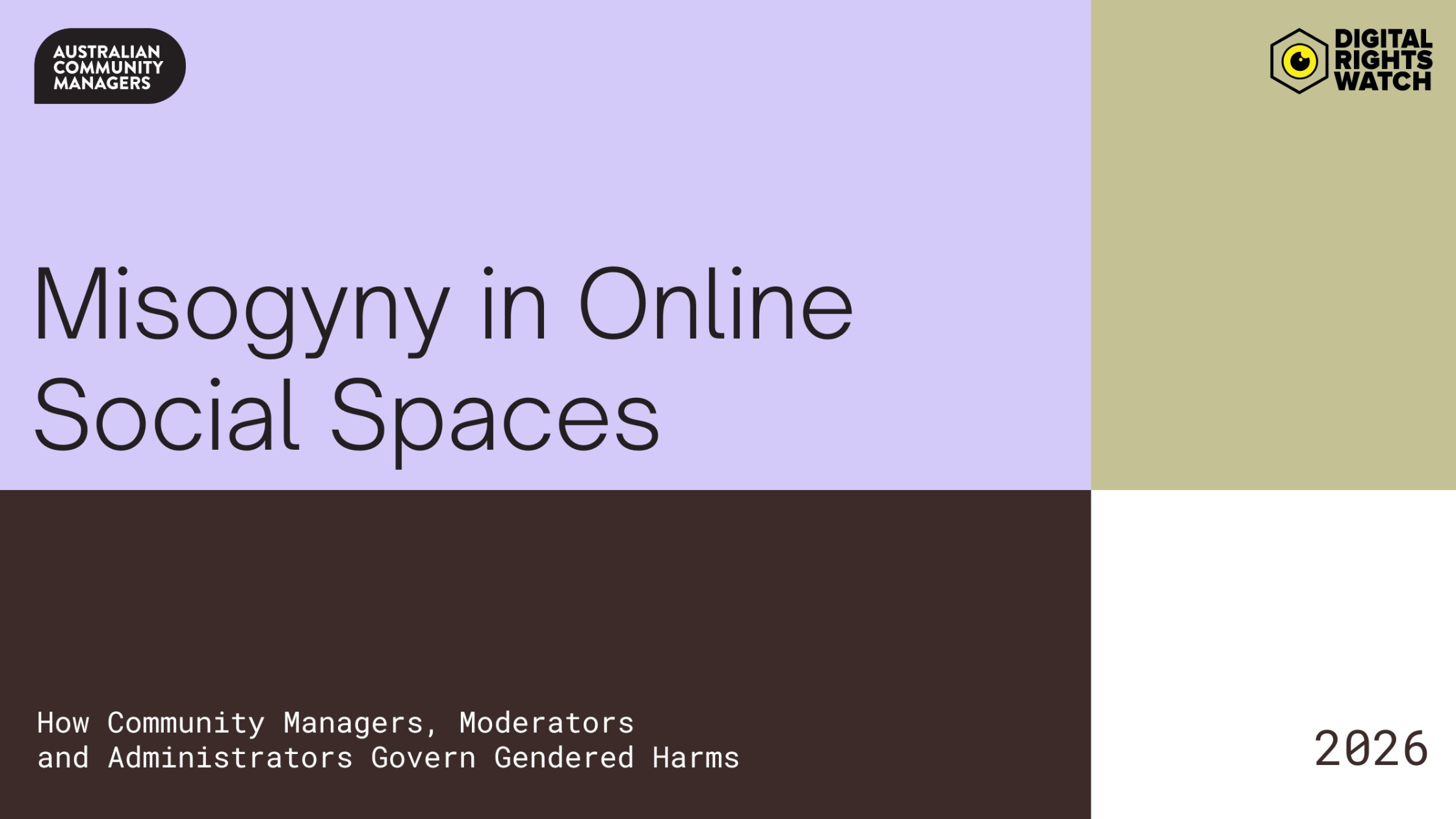
Misogyny in Online Social Spaces: How Community Managers, Moderators and Administrators Govern Gendered Harms is a mixed-methods study, co-authored with Dr Jennifer Beckett, drawing on survey and interview data from Australian community managers, social media managers and moderators.
It asks two questions: what makes online social spaces safe for women and diverse voices, and what techniques practitioners already use, or could be supported to develop, to build those spaces. We're grateful to Digital Rights Watch for trusting ACM with this research and giving us the opportunity to put practitioner experience at the centre of it.
Misogyny is everyday
Across professional associations, gaming communities, advocacy groups, local government, news outlets and brand communities, respondents described misogyny as routine, not rare.
It shows up as an assumption of male superiority, in narratives of male victimhood, and in ideas drifting in from the online manosphere.
Practitioners rarely read it in a single comment. They read it as a pattern, building across conversations, relationships and time.
If you allow it through, it can turn into a pile-on. People see that someone said a really crook thing and think, time for my hot take. What people see is what they imagine is acceptable. — Robyn, agency-based community manager
Respondents described a chilling effect on participation: women and other targeted members posting less, splitting off into smaller private spaces, or leaving altogether.
Where a healthy community bifurcating to accommodate growth can be a good sign, this hostility-driven version is the opposite, a sign the original space has failed to protect the people already in it.
Practitioners have deep experience and skills
One of this report's central findings is that practitioners are performing sophisticated and nuanced moderation work, informed by lived experience, training and longstanding professional practice.
They're applying what we call contextual forensics: reading behaviour against community memory and the broader digital landscape, weighing mitigating factors, then choosing between education, restoration and enforcement. It's a three-phase process most platforms don’t recognise and aren’t designed to support, built on relationship, history and care.
Respondents described checking in with affected members, connecting them to support, and reducing their exposure to further harm, work that sits well outside standard content-removal frameworks.
When institutions don't back their own people
The report also documents a concerning pattern of institutional betrayal.
Practitioners who raised serious safety concerns were sometimes met with minimisation, delay, or an organisation more concerned with reputational risk than with the person doing the work.
They're not prepared to back you, they're not prepared to put things in place, and you end up just having to leave, because that's the only way to escape it. — Claire, community management consultant
Other respondents described what a difference explicit institutional backing makes, feeling empowered to act without fear of being second-guessed. Institutional courage exists, but it's currently a matter of individual leadership, not a structural guarantee.
What needs to happen next
These matters are increasingly urgent. The attack on Independent Member for Indi, Dr Helen Haines, outside her Wangaratta electorate office has shocked Australians and forced urgent questions about the temperature of our public life and the role of social media in tending the heat. Almost nine in ten Australian women in elected office or running for it report online abuse linked to their political role, and three-quarters say it has worsened in the past two years.
A 2026 University of Melbourne survey found hostility toward women is now the single strongest predictor of support for violent extremism, ahead of ideology, religion or time spent online.
In August 2026, national cabinet acknowledged that rates of intimate-partner homicide and sexual violence remain unacceptably high, at the halfway point of the 10-year National Plan to end violence against women and children, a sign that policy is still catching up to how fast the harm is evolving. Meanwhile new threats like “pervert glasses” are emerging.
Three findings in this report deserve attention from platforms, policymakers, funders and the organisations that rely on this work:
The psychosocial risks of moderation need formal recognition as an occupational health and safety issue, with obligations sitting on employers and platforms, not only on the individuals absorbing the impact.
Meaningful accountability for misogynistic behaviour requires coordinated action across government, business and civil society. Informal, practitioner-led governance can't indefinitely substitute for structural accountability.
This is an embedded, largely untapped workforce. Organisations, governments and safety actors have insights available to them that they aren't yet using, and expertise they aren’t yet deploying.
Community managers, moderators and social media managers are already doing sophisticated governance work, often without the formal recognition, training or support the difficulty of that work warrants. The task now isn't to invent new solutions. It's to recognise, resource and scale the ones already in practice.
The full report, including the research design, all findings and our detailed recommendations for next steps, is available via ACM's research page.
We're proud to have produced this report, and grateful to Digital Rights Watch for the opportunity to lead such an important piece of research on their behalf. Our thanks to the community managers, moderators and social media managers who gave their time, and their trust, and to the Minderoo Foundation for making the work possible.