On Wednesday 18 November, 2026, ACM Director Dr Venessa Paech and Director of Research Dr Jennifer Beckett appeared before the Parliamentary Joint Committee on Intelligence and Security.
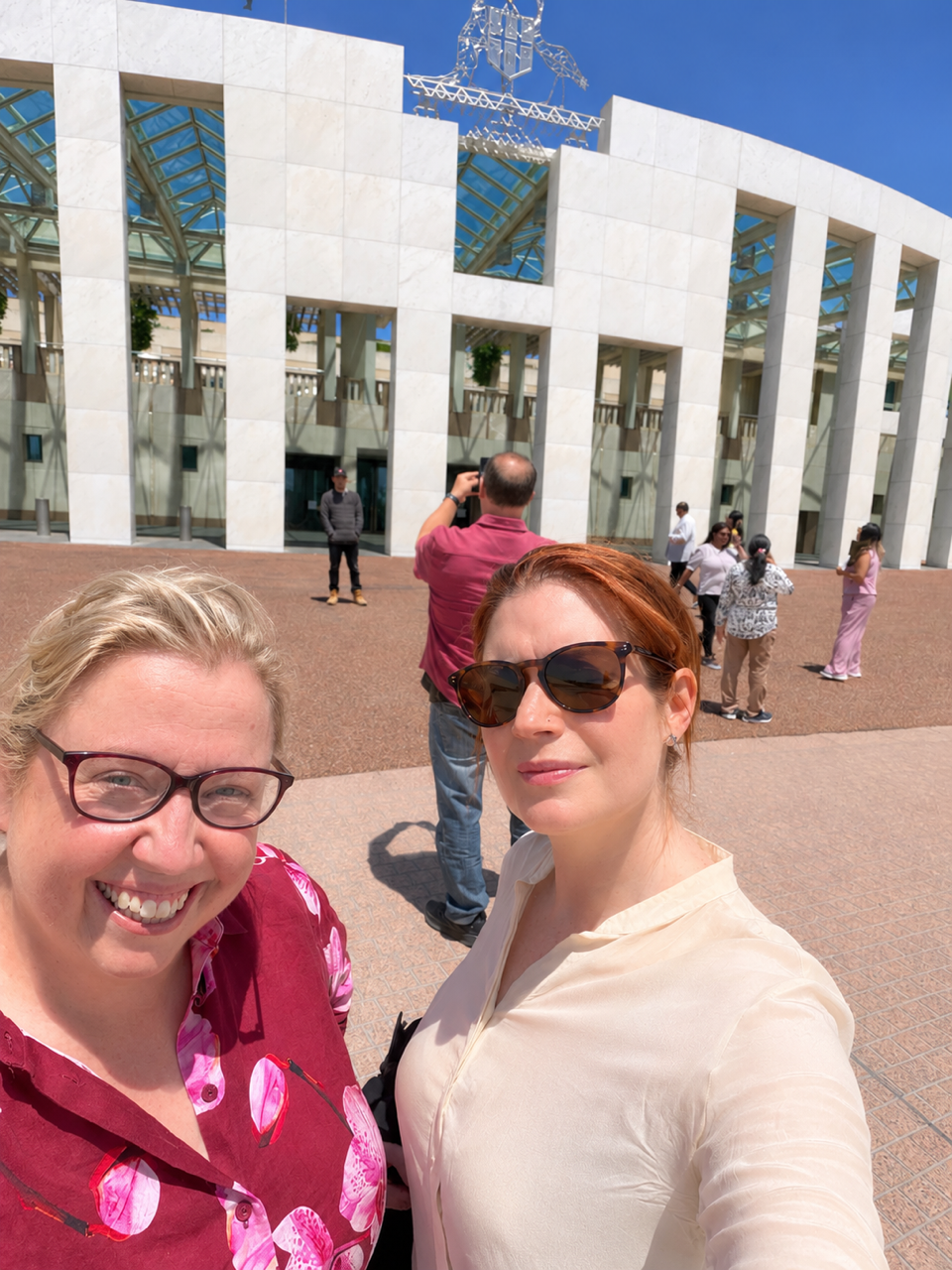
ACM Director Dr. Venessa Paech and Head of Research Dr. Jen Beckett.
ACM gave evidence to its inquiry into the nature and drivers of radicalisation in Australia, building on our written submission.
We are not experts in terrorism or national security, and we deferred to the agencies on those questions.
What we bring is deep expertise in how people gather and form culture online, and in the professional practice of stewarding those spaces.
Our members run Facebook groups, mental health forums, Discord servers and gaming communities, and many are social media managers for news organisations and government.
Community stewards (whatever their title) are often the first to notice when someone in their space starts to change.
A first for our profession
Our opening statement entered a definition of online community management into the official parliamentary record, for the first time:
Online community management is the professional practice of building and governing online groups so that people can connect safely and productively. Moderation is a core part of that work, but it is also a distinct practice focusing on upholding a community's rules and norms and on mitigating and responding to risks and harms.
What we told the Committee
The early signs are relational. Practitioners see imported lexicons, hardening language and shifts in how a member reacts to familiar situations. Spotting these depends on knowing a community well, which automated systems and distant, foreign owned platform operators, struggle with.
Belonging is the mechanism. Harmful groups recruit by meeting the same needs community managers design for: information, friendship, entertainment and ongoing support. By standard measures of community health, these groups are often remarkably healthy. Our 2022 research on manosphere communities found exactly this. Their members are also highly sensitive to surveillance, and any sign of being watched can deepen their sense of community.
Dispersal is not disengagement. Deplatforming without off-ramps can feed the victimhood stories at the heart of these communities. Members regroup elsewhere with stronger attachment and grievance. When Reddit banned r/The_Donald and r/Incels, both communities rebuilt on standalone sites, and r/The_Donald showed increased signals of toxicity after migrating. Whittaker and Craanen (2025) find that content removal pushes extremists into more ideologically homogenous clusters. We support disruption, and recommend relational approaches informed by community management practice sit alongside it. Responses should also look upstream, to platform and recommender system design that does not amplify extreme content.
Timing is key. Each time a community migrates platforms, it sheds its less committed members, leaving a more deeply engaged core. Restorative approaches are unlikely to reach people who are already radicalised. They work earlier, when worrying behaviour first surfaces in mainstream spaces and a community manager can still keep that person connected.
Community management belongs in the solution. Community management practice (including design, engagement and governance of digital sociality) can play a useful and strategic role in responses to radicalisation. Understanding how a group's belonging works makes it possible to interrupt that belonging, offer credible alternatives and open genuine off-ramps for members.
The evidence for these methods is promising. Simply making community norms visible improved newcomers' compliance with rules, and empathy-based responses to racist hate speech reduced future hate speech where warnings did not. We were clear with the Committee that these findings come from general online settings rather than radicalised ones.
The workforce needs support. Practitioners escalating to mainstream platforms hit a ceiling, and commercial engagement metrics often work in opposition good moderation. Professionals generally have escalation protocols mapped, while many volunteers and solo operators do not. We called for increased (potentially mandated) training, and for greater collaboration with agencies and platforms on the tools and reporting infrastructure that make escalation easier. ACM's decade of State of Community Management data shows practitioners' exposure to harmful material holding steady while their stress rises and organisational support falls. Many describe a sense of institutional betrayal when platforms fail to act on what they escalate.
Volunteers are part of the front line. Many Discord servers and Facebook groups are run by volunteers, some of them very young. It may not be fair, but they are effectively part of the front line. In our experience, most feel a strong duty of care to their members and are open to guidance on how to govern well. Resources, mentoring and training for this cohort are a real opportunity.
Misogyny is a common thread. Our research participants consistently report that extremist ideologies arrive in their communities packaged in misogyny, whatever their religious or political origin, and often escalate from there. While this is far from the only social signal involved, it is a key one.
We also put on the record that most Australians do not experience online and offline harm as separate. To them, it is all "real" life. Policy and political debate that assumes a hard divide between the two treats online life as an abstraction, and misses how people actually live and experience harm.
Why this matters
Asked what community managers most need, we named visibility, better tools and a place in the conversation about solutions. Commercial content moderators working for platforms are increasingly discussed (rightfully), while the Australians, paid and volunteer, who steward the spaces where millions of us gather every day are much less legible. Big Social platforms need to equip these practitioners properly, as escalated reports too often disappear without useful action. Smaller and independent platforms are typically more open to working with us and letting practitioner expertise inform their design and affordances. That collaboration is good for everyone, and it should be the norm.
And the research and practice base they draw on can help design the responses this inquiry is looking for. We encouraged the Committee to recommend investment in research on how moderated communities can act as alternative spaces of belonging for people at risk of radicalisation, an area where practitioner knowledge has never been systematically documented.
What's next
The Hansard transcript is available on the Parliament of Australia website, and you can read our ACM submission here.
If you’ve seen radicalising behaviour take shape in a community you manage, or have ideas or experience around governing it, we'd love to talk more.
Giving evidence to Parliament is a privilege, and we are grateful for it. Thriving communities are essential to a healthy, deliberative democracy and to our social cohesion. Community managers are the stewards who help keep them that way.
References
Australian Community Managers (2025). State of Community Management Report. https://www.australiancommunitymanagers.com.au/research
Hangartner, D. et al. (2021). Empathy-based counterspeech can reduce racist hate speech in a social media field experiment. Proceedings of the National Academy of Sciences, 118(50), e2116310118. https://doi.org/10.1073/pnas.2116310118
Horta Ribeiro, M., Jhaver, S., Zannettou, S., Blackburn, J., Stringhini, G., De Cristofaro, E. and West, R. (2021). Do platform migrations compromise content moderation? Evidence from r/The_Donald and r/Incels. Proceedings of the ACM on Human-Computer Interaction, 5(CSCW2). https://doi.org/10.1145/3476057
Matias, J. N. (2019). Preventing harassment and increasing group participation through social norms in 2,190 online science discussions. Proceedings of the National Academy of Sciences, 116(20), 9785–9789. https://doi.org/10.1073/pnas.1813486116
Paech, V. and Beckett, J. (2026). Misogyny in online social spaces: How community managers, moderators and administrators govern gendered harms. Digital Rights Watch and Australian Community Managers. https://www.australiancommunitymanagers.com.au/research
Parliament of Australia (2026). Committee Hansard: Parliamentary Joint Committee on Intelligence and Security, Inquiry into the nature and drivers of radicalisation in Australia, 18 November 2026, Canberra.
Trott, V., Beckett, J. and Paech, V. (2022). Operationalising 'toxicity' in the manosphere: Automation, platform governance and community health. Convergence: The International Journal of Research into New Media Technologies. https://doi.org/10.1177/13548565221111075
Whittaker, J. and Craanen, A. (2025). The unintended consequences of the removal of terrorist content and the case of Bitchute. Studies in Conflict & Terrorism. https://doi.org/10.1080/1057610X.2025.2595843