Caring vs. Carrying: A Framework for Sustainable Moderation
Moderation is care work, and care without structure leads to burnout. That was the case Serena Snoad made at ATIM 2026, drawing on 18 years building online communities, including her work as founder of Good Community, a UK consultancy focused on ethical, effective and sustainable community practice.
Here's Serena's framework for community managers, moderators and team leads.
Moderation is care work & broader than people think
Moderation is often minimised as mere enforcement, or worse still, digital janitorial labour (“taking out the trash”).
It spans welcoming and signposting, peacekeeping, modelling tone, and containing harm, each requiring a different skill set and emotional register. Without structure, moderators end up wearing all of these hats at once, or trying to, and wearing none of them well.
Care expands to fill the space
Because moderators are selected and trained for their capacity to care, that care will generally keep expanding to cover everything, unless their role and function has clear boundaries.
When this happens, people can start to feel responsible for member life circumstances, platform features, team dynamics and organisational issues, none of which are actually theirs to fix.
The result is emotional and mental energy spent without producing any constructive change.
Patterns of caring
When care has no structure, Snoad suggested that it settles into three recognisable personas:
The over carer. Can't let go, takes things personally, feels responsible for everything. Underlying belief: because I care, I have to do all I can to make everything better.
The boundary crosser. Steps outside their remit, contacts members directly, promises things they can't deliver. Underlying belief: someone has to do something, and no one else will.
The avoider. Hesitates, escalates or defers when a decision is needed, frozen by the fear of getting it wrong. Underlying belief: I might get it wrong, so it's better to wait or pass it on.
Each pattern comes from a genuine place of caring (these aren’t character flaws). The fix isn't to care less, it's to give that care somewhere to go.
Circles of Care framework
Adapted from Stephen Covey's circles of control, influence and concern, Snoad offered a framework to give moderators and teams understanding and language for where their energy should sit:
Control: what's yours to action directly, such as handling reports, flagging issues, responding to queries.
Influence: what's yours to escalate or shape, such as a safeguarding concern, a technical bug, or feedback on organisational decisions.
Concern: what you care about but cannot change, such as world events, member choices, or platform decisions made elsewhere.
The point isn't to encourage detachment or numbing. As Snoad put it, the model is "a way of focusing our time and attention and energy on what really matters."
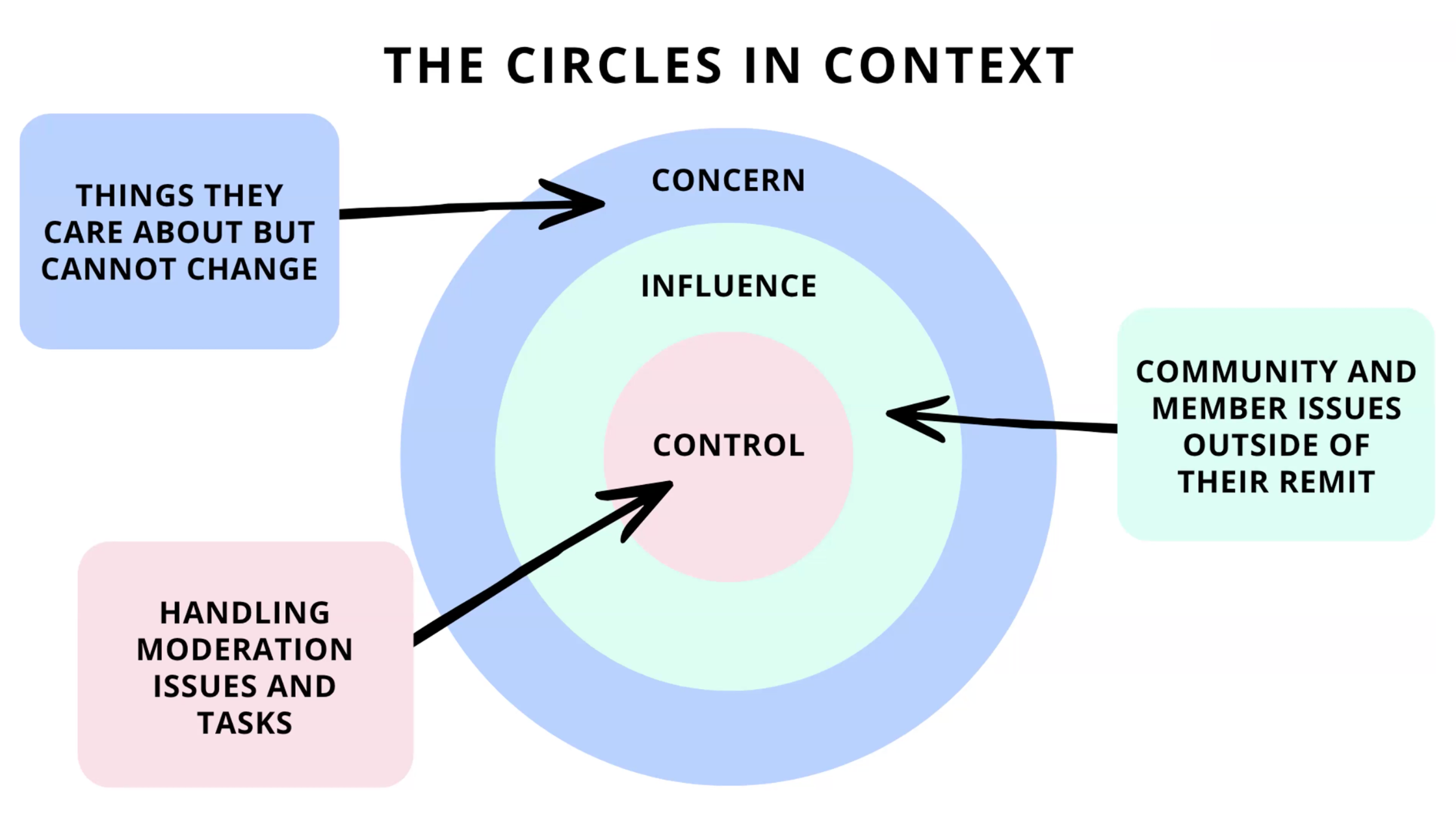
A moderator/community manager adaptation of Covey's control, influence and concern circles. [Image: Serena Snoad, Good Community]
What defines the circles: role, remit, resources
For individuals and teams wanting to apply this, three things shape where the boundaries sit:
Role defines what's in your circle of control: the purpose, key tasks, and what success looks like.
Remit defines the line between control and influence: what's yours, and where you escalate.
Resources determine your capacity to act or influence: the templates, procedures and support available to you.
Diagnostic questions worth asking
For individuals:
What is currently in your circles, and where is your care energy actually going?
What should be in your circles, based on your actual role and remit?
If your circles don't match your job description, that's not your fault. It's a sign something else needs addressing.
For team leads, when these personas show up on a team, the fix usually isn't more individual coaching. Look at the structure first:
Do your moderators know exactly what decisions are theirs to make?
Is scope clearly defined?
When someone escalates, do they know what happens next?
Are you asking people to care about more than they have the capacity to hold?
Is it psychologically safe to say "this isn't mine to carry" on your team?
The takeaway
You can care about everything, but you cannot carry everything. As Snoad noted, citing Adam Grant, the best antidote to burnout isn't better coping skills, it's redesigning the work to reduce structural overload.
Letting go is a practice, not a one-off decision, and boundaries won't make your concerns disappear; they'll just stop those concerns from becoming your job.
Want to hear more from practitioners like Serena? Join us at the next All Things in Moderation to learn from more experts in the field, and explore the future of digital care and community labour. Check out Serena's work directly at Good Community.