Celebrating 10 years of SOCM Reports: 2015 - 2025
The 2025 State of Community Management Report has arrived - and it’s a special one. In an era shaped by AI acceleration, regulatory expansion and platform instability, this report offers something increasingly rare: sustained longitudinal evidence about how community management is actually practiced in our region.
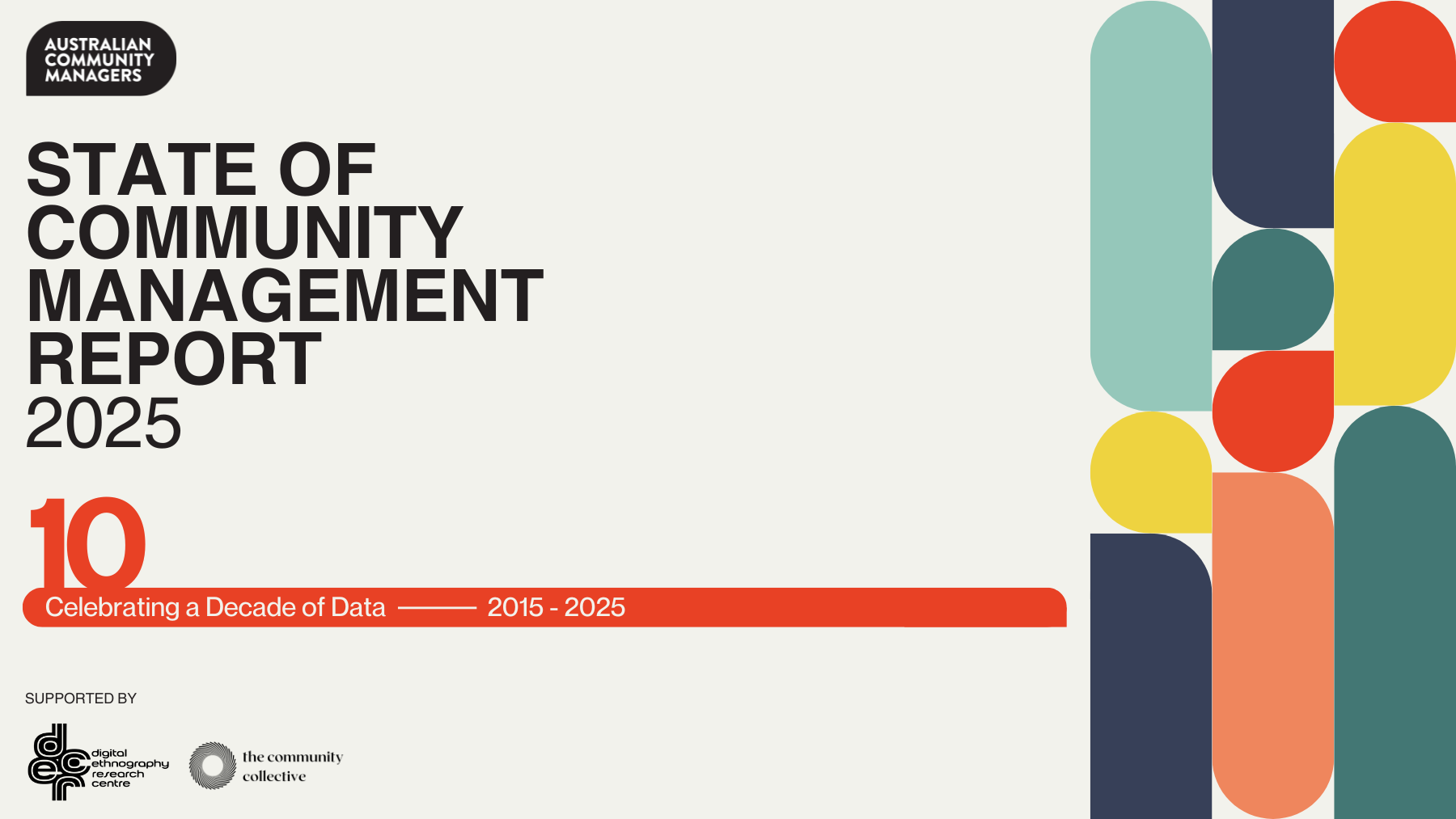
Download the full report to access a decade of benchmarking data on how community management is evolving across Australia and New Zealand.
The ACM SOCM Report remains the only dataset of its kind in our region.
Sincere thanks to Alison Michalk, ACM co-founder and long-standing report partner, whose contribution over many years has shaped this research. Thank you also to our partners and sponsors across the decade, including this year's collaborators at the Digital Ethnography Research Centre and The Community Collective. Most importantly, thank you to the community managers who keep showing up, sharing their experience, and ensuring this practice is documented on its own terms.
We’ve been doing this for 10 years
So what does this bumper 10 year edition reveal? Here are a few of its findings:
The work has grown. The structures haven't.
Community management is now unambiguously strategic. Practitioners are doing governance, risk oversight, measurement design and operational architecture - not just moderation and engagement.
But its formal recognition hasn't kept pace. Fewer job titles actually contain the word "community," a sign that the work is diffusing across hybrid roles rather than concentrating into a distinct, legible function. Strategy is practiced but rarely documented. Career pathways remain murky. Leadership still misunderstands the function more often than it should. Budgets stay tight while compliance expectations grow. The gap between what community managers actually do and what their organisations formally acknowledge is one of the report's most persistent findings.
The platform reckoning
Organisations are quietly retreating from large social platforms - not in crisis, but with intention. After years of chasing algorithmic reach on surfaces they don't control and swatting harms baked into business models, many are returning to bounded, purposeful spaces: communities of practice, private platforms, owned infrastructure. Governed environments offer something US owned mega-platforms no longer reliably provide - stable moderation standards, cultural coherence, more trustworthy data practices and the chance to build community on your own terms.
AI as infrastructure
Enthusiasm has cooled, and the numbers show it. Optimism about AI dropped 11 points to 21% in 2025, while concern rose to match it at 33%. Recognition that AI is actively changing the nature of community management has more than doubled in a single year, from 15% to 33%, even as confidence that the field will remain fundamentally human-focused has fallen from 42% to 29%. A notable 10% of practitioners have stopped using AI tools altogether.
The conversation has shifted. It's no longer "will this change us?" but "how do we navigate the change that's already here?" AI is now normative in technology, practices and attitudes, with practitioners viewing it as an infrastructural condition as much as a toolset.
Download the full State of Community Management 2025 Report to explore the detailed findings and benchmark your own structures against the sector.
If your organisation is working on platform strategy, governance design, measurement frameworks or AI integration, ACM's advisory, training and research services can help: team@australiancommunitymanagers.com.au