What is Community Management?
From early bulletin board systems, Usenet groups, and forums to professional, civic, learning, and peer-support communities, as long as there’s been an Internet, people have always gathered online to share knowledge, coordinate action, care for one another, and build something together. These spaces did not govern themselves by accident. They were actively managed by humans who welcomed newcomers, set norms, mediated conflict, protected participants from harm, and maintained the shared purpose of the group.
Early pioneers named this work. In the mid-1980s, John Coate described it as “cyber-innkeeping”: welcoming people in, modelling norms, tending to relationships, brokering relationships and information (Coate, 1991). He later popularised the name ‘community manager’, and helped the practice become more visible.
It can also be likened to social gardening: creating the conditions for healthy interaction, pruning when necessary, supporting growth, and recognising that communities thrive through care rather than control (Paech & Beckett, 2025).
Today, that work carries increasing formal responsibility. Community managers are frequently responsible for interpreting and applying platform rules, organisational policies, and external legal or regulatory requirements within specific social contexts. They act as micro-regulators: exercising judgement, discretion, and care in real time, with tangible consequences for people, organisations, and communities.
Understanding what community management is — and how it differs from social media management — matters because these practices work differently, excel at different tasks, solve different problems, and are measured in different ways. Confusing them leads to misaligned expectations, inappropriate tooling, and fragile social systems.
Community management is the practice of intentionally stewarding relationships, norms, shared purpose, and value exchange within a group, enabling ongoing participation and sustaining a collective over time. It is concerned with holding social context, guiding behaviour, and maintaining the conditions that allow people to interact safely and meaningfully, within technical, organisational, and regulatory constraints.
It happens online, offline and spaces in between; many communities are distributed across an ecosystem of places and spaces.
How community management works
Community management is a many-to-many practice.
It focuses on:
relationships between members, not just between an organisation and an audience
shared norms and values, not just formal rules
long-term participation, not short-term attention (time well spent vs time spent)
collective value creation, not only organisational outcomes
Community managers design and maintain the social infrastructure of a group. This includes:
clarifying purpose and boundaries
onboarding and orientation
norm-setting and role modelling
conflict mediation and repair
governance design and escalation pathways
monitoring social and psychological health
retaining context, history, and cultural memory
Moderation and safety work are part of this practice, but they do not define it. Moderation, trust, and safety are standalone professional domains, each with distinct expertise, that intersect with community management without replacing it.
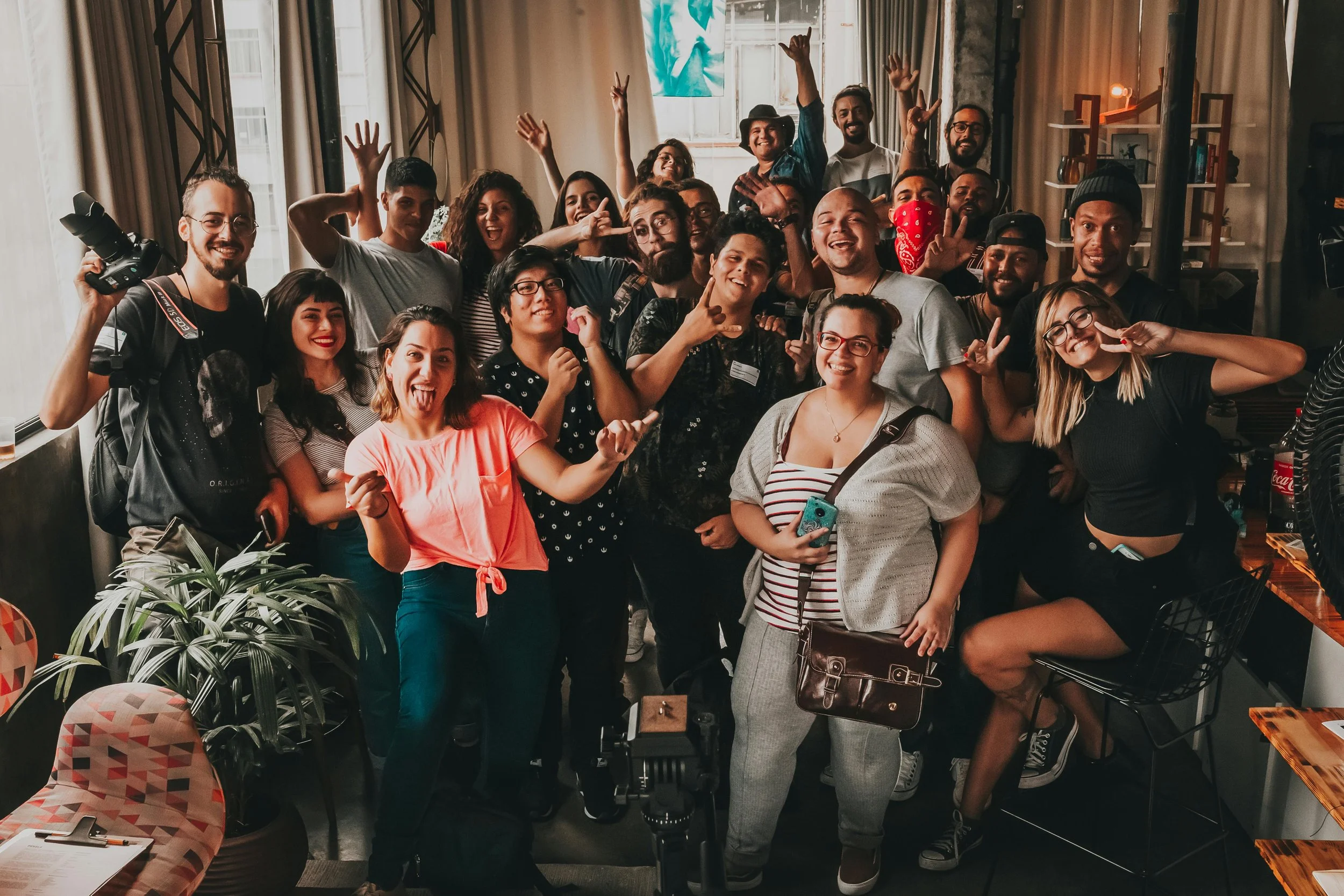
Image: Matheus Bertelli
Community management or social media management?
Community management and social media management are often conflated.
This conflation frequently appears in hiring and recruitment, where job descriptions collapse community management, social media management, customer support, moderation (and even more) into a single role. The result is roles that are impossible to perform well, unclear performance expectations, and chronic misalignment between what organisations need and what they hire for.
Community management emerged alongside the early web as a response to the social challenges of shared digital spaces. Social media management is a more recent professional practice, developing as brands and creators began harnessing the commercial, promotional, and marketing opportunities offered by social media platforms.
The two practices overlap in skills and tactics, but they are designed for different social systems, responsibilities, and problem areas.
Community Management
What it is good at solving:
Building and organising shared knowledge over time
Supporting peer-to-peer learning and mutual aid
Facilitating collaboration and collective problem-solving
Sustaining professional or interest-based communities of practice
Providing peer support in moments of need or uncertainty
Holding long-term institutional or community memory
How it operates:
Structure: Many-to-many
Primary role: Relational governance and stewardship around shared purpose
Focus: Inward; purpose, norms, trust, and shared value exchange
Time horizon: Longer-term and continuous
How success is measured:
Retention and sustained participation
Quality and usefulness of contributions
Community health and wellbeing
Trust, cohesion, and resilience
Ability of the community to support itself over time
Community management can sit in any department within an organisation, or on its own. It is often adjacent to areas like marketing, membership and user experience.

Image: Pixabay
Social Media Management
What it is good at solving:
Amplifying messages, stories, and campaigns
Increasing visibility and awareness
Reaching new audiences at scale
Responding to customer queries and issues in public-facing spaces
Managing brand presence and reputation across platforms
Driving traffic, engagement, or conversion toward organisational goals
How it operates:
Structure: One-to-many
Primary role: Communication, promotion, audience engagement, and customer support
Focus: Outward; messaging, visibility, reach, and responsiveness
Time horizon: Campaign-based or short-term
How success is measured:
Reach, impressions, and audience growth
Engagement rates and sentiment
Response times and resolution
Campaign performance and conversion
Social media management often sits under marketing or advertising, and can intersect with customer service.
Both involve moderation and risk management, and both can support organisational goals.
Techniques from each can strengthen the other: social media can help communities tell their story and market their value, set expectations, attract the right participants, and influence the wider landscape.
Meanwhile community management practices can deepen trust, reduce risk, improve retention, and add context and continuity to social media engagement.
We can build communities on and using social media (of course), but that’s often not the primary goal (and certain platforms are designed to make that more difficult).
Where moderation, trust & safety fits
Moderation and trust and safety are professional domains in their own right.
Moderation focuses on behavioural oversight, norm enforcement, and intervention. (And within moderation there are many layers of work and focus, such as commercial content moderation at the platform level, and agency facilitation moderation for risk and reputation management)
Trust and safety focuses on harm prevention, risk mitigation, and compliance, usually at platform scale.
Within community management, these practices are applied contextually, informed by local norms, relationships, and purpose. Outside it, they may operate independently, often without responsibility for the long-term social life of a particular group.
Community managers navigate the intersection of these domains, applying policy and regulation with situational awareness and social judgement. This is why their role increasingly resembles that of a distributed regulatory function, embedded within communities themselves.
How these practices support one another
Community management, social media management, moderation, and trust and safety are not in competition.
Social media practices can help attract the right participants and signal purpose.
Community management sustains relationships, shared knowledge, and value once people arrive.
Moderation and trust and safety expertise strengthen communities when aligned with context rather than imposed without it.
Problems can arise when one practice is expected to substitute for another, or when success is measured using the wrong lens.
References
Coate, J. (1991). Cyberspace inn-keeping: Building online community.
Paech, V., & Beckett, J. (2025). Reclaiming the web: The cozy turn and the re-decentralisation of online community governance [Conference presentation]. Australian and New Zealand Communication Association Conference (AANZCA 2025)