A Playground Framework for Community Design
I was listening to an episode of 99 Per Cent Invisible recently (one about the legendary Jane Jacobs, neighbourhoods and Sesame Street) – and it lit up a chain of (admittedly very Gen-X coded) thoughts. The discussion turned to the relationship between Sesame Street’s neighbourhood and its relationship to principles of vibrant urban design: textured, social, a little messy, full of familiar rhythms and characters.
It got me thinking about the strong relationship between community work and neighbourhood building, and somewhere in that reflection, I decided on a playground inspired framework for thinking about community design: swings, slides, see-saws and sandboxes.
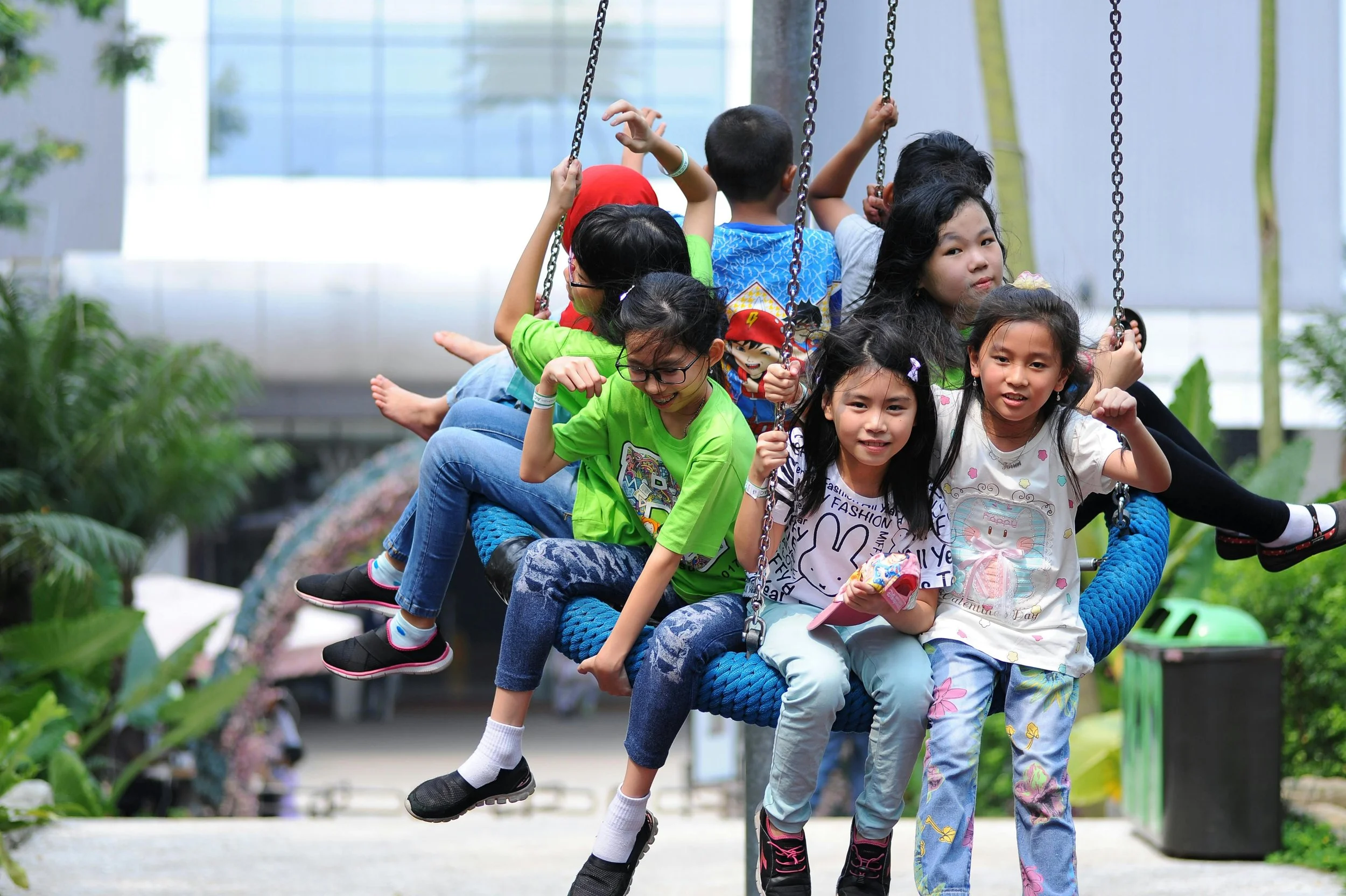
[Photo: Nasirun Khan] Squish onto a giant swing with fellow humans and take some risks.
Swings: Rhythm and Return
Swings are about momentum, but they’re also about choice. You can swing alone, finding your personal rhythm. You can swing in pairs, syncing up with someone else’s timing. Or you can pile into one of those giant basket swings with half the playground and move together as a group.
Communities work the same way. Swings represent the rituals and recurring touchpoints that different kinds of members can join in at their own pace: weekly threads, scheduled gatherings, familiar formats that create a sense of continuity and shared identity. They keep people coming back and help them feel the heartbeat of the place (whether that place is singular, or an ecosystem).
Slides: Clear, Supportive Pathways
Slides make it obvious where to start and how to get to the bottom without anxiety. Good community slides are journeys: onboarding that orients, guidelines that clarify, navigation that doesn’t send people into cognitive knots.
Slides reduce obstructive friction (not the good kind), and help members navigate through the space in ways most meaningful to them. They’re handrails, but you can still scamper up backwards, break the rules, and slide down in a weird position if you feel like it.
See-Saws: Reciprocity and Balance
A see-saw only works with someone else on the other end. It’s reciprocity embodied. Communities depend on balanced contribution: conversation, support, emotional labour, co-creation. When the load becomes uneven, the whole thing tips and can’t sustain itself. Community stewards help keep the social weight distributed fairly and sustainably.
We don’t always match up neatly with our other person when we clamber on, but together, we figure out how we can see and saw without casualties.
Sandboxes: Creativity and Co-Design
A sandbox is where kids make stuff and muck about; experiment, test boundaries, collaborate, rebuild and imagine new worlds. (And we might throw sand at one another occasionally). Online communities need this energy too. Sandboxes are the member-led zones or shared activities where people get to shape culture, build together, test ideas and innovate. These spaces thrive under light governance, not heavy-handed control. They might give rise to ideation, or new ways to think about identity and expression.
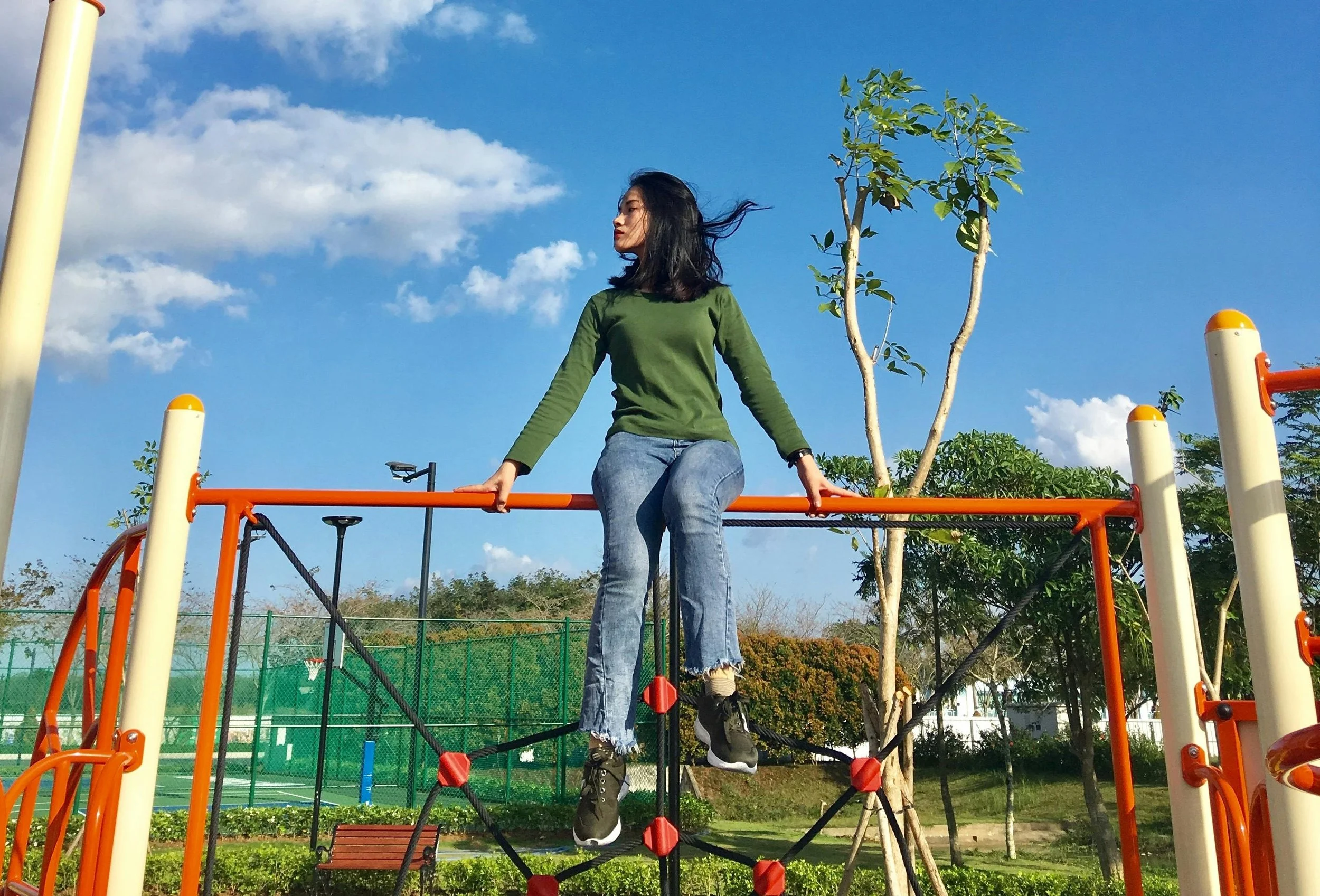
[Photo: Hy Ann] Nhơn Trạch, Đồng Nai, Vietnam
Free-Range Community
Thinking back to the playgrounds I grew up with in the 1970s, there’s another design lesson worth holding onto: they built in risk. (If we’re being honest, quite likely out of ignorance, but the point stands). You could fall off the monkey bars. You could slip. You could get something wrong in front of other kids. And somehow, that was the point.
You built resilience. You tried again. You learned your limits and your strengths. You learned how to ask for help when you needed it.
Recently we’ve see whispers of this ‘free-range’ philosophy return. A “risky playground” in Melbourne – part sculpture, part social experiment – has been celebrated for designing toward social challenge rather than away from it. It lets kids climb higher, take calculated risks, problem-solve together and stretch their comfort zones without being micromanaged. It’s a deliberate counter to mollycoddling that wants to smooths every rough edge.
Healthy communities mirror this. Over-sanitised, hyper-optimised environments can look safe, but they often shut down growth. People become cautious, performative or dependent on rules to feel secure. They can fall into group-think. Real community needs room for vulnerability, friction and occasional wobbles. The more we expect this, allow it, and proactively design for it in our architectures and socio-cultural stewardship, the more we exercise these muscles together.
A good community design and governance framework should support people, not bubble-wrap them. It should offer space for members to try things, fail a little, succeed a lot and grow together.
Playgrounds taught us this. Communities remind us of it.